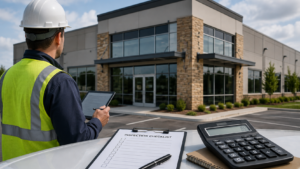
Buying a commercial property is a major financial decision, and the condition of the building can affect much more than the purchase price. Roofing problems, aging HVAC equipment, drainage concerns, electrical issues, plumbing defects, or deferred maintenance can all influence your plans for the property after closing.
That is why many buyers and investors want to know the commercial property inspection cost before moving forward with their due diligence.
Unlike a typical residential inspection, commercial properties can vary significantly in size, use, age, construction, occupancy, and complexity. For that reason, commercial inspection pricing is usually based on the specific property and the scope of work rather than a single flat rate.
Understanding what determines the cost can help you request the right inspection, compare proposals more accurately, and make a better-informed investment decision.
How Much Does a Commercial Inspection Cost?
There is no single price that applies to every commercial property.
The commercial inspection cost for a small retail suite will naturally be different from the cost of evaluating a large warehouse, office building, restaurant, or multi-building property.
An inspector may consider factors such as:
- Building size and square footage
- Property type and intended use
- Age and overall complexity of the building
- Number of structures
- Roof configuration and accessibility
- HVAC and mechanical systems
- Electrical and plumbing systems
- Occupancy and access limitations
- Requested inspection scope
- Due diligence deadlines
- Additional specialty services or consultants
Because these factors can vary substantially from one property to another, buyers should be cautious about treating commercial inspection pricing as a simple commodity.
A more useful question is not only “How much does a commercial inspection cost?” but also:
“What am I getting for that cost, and does the inspection scope match the risks associated with this property?”
What Determines Commercial Property Inspection Cost?
Several factors can influence the final quote. Understanding them can also help buyers and investors provide inspectors with the information needed to prepare an appropriate scope.
1. Property Size
Square footage is one of the most obvious pricing considerations.
A larger property generally requires more time to evaluate because there may be more roofing, exterior walls, interior spaces, electrical components, plumbing fixtures, HVAC equipment, and site features to inspect.
However, square footage alone does not determine the final price.
Two buildings of the same size can require very different inspection scopes.
A relatively simple warehouse, for example, may present different inspection requirements from a similarly sized medical office or restaurant with more complex mechanical, plumbing, and interior systems.
2. Type of Commercial Property
The property’s use can significantly affect commercial property inspection pricing.
Commercial inspections may involve properties such as:
- Office buildings and professional suites
- Retail stores and shopping spaces
- Warehouses
- Light-industrial buildings
- Restaurants
- Medical or professional offices
- Owner-occupied business properties
Each property type presents different systems, layouts, accessibility considerations, and potential areas of concern.
Understanding the property type helps the inspector determine the appropriate inspection scope before providing a quote.
3. Age and Condition of the Building
Older commercial properties may require additional attention because building systems can have different ages, modifications, repairs, or maintenance histories.
An older building may contain:
- Aging roofing materials
- Older HVAC equipment
- Previous electrical modifications
- Plumbing repairs or alterations
- Signs of deferred maintenance
- Moisture-related damage
- Foundation or structural movement indicators
A newer building is not automatically problem-free, either. Construction deficiencies, drainage concerns, installation problems, or incomplete work can still be present.
The objective of the inspection is to document observable conditions—not make assumptions based solely on the building’s age.
4. Number and Complexity of Building Systems
Commercial buildings can contain significantly more equipment than a typical home.
Depending on the property, an inspection may involve reviewing visible and accessible components of:
- Roofing and roof drainage
- Building exterior and envelope
- Foundation and structural components
- HVAC and mechanical equipment
- Electrical systems
- Plumbing systems
- Interior spaces and common areas
- Parking and site drainage
- Visible life-safety and access features
A building with multiple HVAC units, electrical panels, roof sections, tenant spaces, or mechanical systems can require substantially more inspection time than a simpler property.
This complexity can affect the overall commercial inspection cost.
5. Property Access and Occupancy
Access matters more than many buyers initially expect.
An occupied commercial building may contain tenant spaces, locked mechanical rooms, roof access restrictions, operating businesses, or areas that can only be inspected at certain times.
Before the inspection, it is helpful to determine whether the inspector will have access to areas such as:
- Roofs
- Electrical rooms and panels
- Mechanical rooms
- Utility areas
- Tenant spaces
- Storage rooms
- Exterior equipment
- Common areas
Restricted access can limit what can be observed during an inspection.
Providing accurate access information when requesting a quote helps establish a more realistic scope from the beginning.
6. Inspection Scope
Not every commercial client needs exactly the same type of assessment.
A buyer evaluating a property before closing may have different concerns from a tenant considering a long-term lease or an owner planning future maintenance.
For example, a buyer may be particularly interested in identifying visible conditions that could affect negotiations or near-term ownership costs.
An investor may be focused on deferred maintenance and significant building-system concerns.
A tenant may want a clearer understanding of property conditions before accepting certain maintenance responsibilities under a lease.
The agreed scope should reflect the client’s objectives and the characteristics of the property.
For buyers and investors in the Houston area, Kingdom Inspections provides commercial property inspection services in Houston with property-specific scopes based on the building and the client’s needs.
7. Additional Specialty Evaluations
A general commercial property inspection may identify conditions that warrant evaluation by a specialist.
Depending on the property and transaction, additional services or specialists may be appropriate for areas such as specialized roofing systems, engineering concerns, environmental assessments, mold, sewer systems, or other property-specific conditions.
These services should not automatically be assumed to be part of a standard commercial inspection.
This is another reason buyers should compare scope as well as price when reviewing commercial inspection proposals.
Does Commercial Inspection Pricing Work by Square Foot?
Commercial inspections are sometimes priced using square footage as one consideration, but a simple price-per-square-foot calculation does not always tell the complete story.
Consider two hypothetical 20,000-square-foot properties.
One is an open warehouse with relatively simple interior spaces.
The other contains multiple tenant suites, several HVAC systems, extensive plumbing, numerous electrical panels, and more complex interior areas.
Even though the buildings have identical square footage, the time and complexity involved in inspecting them can be very different.
For this reason, square footage can be useful when developing a quote, but it should be considered alongside property type, systems, access, scope, and other relevant factors.
What Should Be Included in the Inspection Price?
Before selecting an inspector based on price alone, buyers should understand what the proposed inspection actually includes.
Ask questions such as:
- Which building systems will be inspected?
- Are the roof and exterior included?
- Will site drainage and parking areas be evaluated?
- Which HVAC, electrical, and plumbing components are within the scope?
- Are accessible tenant and common areas included?
- Will photographs be included in the report?
- Will significant findings be summarized?
- Is post-inspection consultation available?
- Are there important exclusions or access requirements?
- When should the report be expected?
Two quotes that appear similar may represent very different scopes.
A lower price is not necessarily a better value if important areas of the property fall outside the inspection being proposed.
Why the Cheapest Commercial Inspection May Cost More Later
Commercial real estate decisions often involve much larger financial exposure than the inspection fee itself.
Consider the potential significance of conditions involving:
- Roof deterioration
- Aging HVAC equipment
- Water intrusion
- Drainage problems
- Electrical deficiencies
- Plumbing concerns
- Foundation movement
- Deferred maintenance
The purpose of an inspection is not to predict every future repair or guarantee that a building will never develop problems.
Instead, a professional inspection provides documented information about observable conditions at the time of the assessment.
That information can help a buyer decide whether additional specialist evaluations are needed, whether certain concerns deserve further investigation, or whether observed conditions should factor into negotiations and ownership planning.
The value of an inspection should therefore be considered in the context of the property and the financial decision being made—not simply as another transaction expense.
Commercial Property Inspection Costs in Houston: Local Factors Matter
Houston commercial properties face environmental conditions that can influence what deserves attention during an inspection.
Heat and HVAC Demand
Houston’s long periods of high temperatures can place substantial demand on commercial cooling systems.
For buyers and investors, the number, apparent condition, and operation of accessible HVAC equipment can therefore be important considerations.
Heavy Rain and Drainage
Houston can experience significant rainfall.
Site grading, parking-area drainage, roof drainage, ponding, and visible evidence of water intrusion can all be relevant during a commercial property inspection.
Humidity and Moisture
High humidity makes moisture-related observations particularly important.
Visible staining, damaged materials, condensation-related conditions, and other indications of moisture intrusion may warrant further investigation depending on what is observed.
Soil Movement
Soil conditions and changes in moisture levels can contribute to movement in buildings throughout the Houston region.
Visible cracking, uneven conditions, or other apparent signs of movement should be documented when they fall within the inspection scope.
Local conditions are one reason a commercial inspection should be more than a generic walk-through of the building.
Commercial Inspection vs. Property Condition Assessment
Buyers may encounter terms such as commercial inspection and Property Condition Assessment (PCA) while researching inspection costs.
They should not automatically be treated as interchangeable services.
A commercial inspection can be customized around the property and client’s objectives. A formal Property Condition Assessment may follow a specific scope or standard, such as requirements established by a lender or investor.
If your lender, investment group, attorney, or other party requires a particular standard or deliverable, provide those requirements before the inspection scope is finalized.
Doing so helps ensure that you are requesting—and pricing—the appropriate service.
How to Get an Accurate Commercial Inspection Quote
The easiest way to receive a meaningful quote is to provide detailed property information from the beginning.
Before contacting an inspector, gather:
- Property address
- Property type
- Approximate square footage
- Number of buildings
- Current occupancy
- Intended use
- Available access information
- Due diligence or closing deadline
- Known areas of concern
- Any lender or investor requirements
The more accurately the property and objectives are described, the easier it is to establish an appropriate inspection scope.
Be cautious about comparing quotes without comparing what each inspector intends to inspect.
Price matters. Scope matters more.
Is a Commercial Property Inspection Worth the Cost?
For buyers and investors, the inspection fee is generally small in comparison with the financial commitment involved in purchasing or leasing commercial real estate.
A commercial inspection can provide valuable information about visible property conditions before major decisions are finalized.
Depending on the findings, that information may help you:
- Better understand the property’s current condition
- Identify areas that may require additional specialist evaluation
- Recognize visible deferred maintenance
- Ask better questions during due diligence
- Prioritize potential repairs or maintenance
- Make more informed negotiation and ownership decisions
An inspection cannot eliminate every risk associated with commercial real estate.
It can, however, replace some of the uncertainty with documented information.
And when significant capital is at stake, better information can lead to better decisions.
Request a Commercial Property Inspection in Houston, TX
There is no universal commercial property inspection cost because there is no universal commercial building.
Property size, use, complexity, systems, access, inspection scope, and client requirements all affect commercial inspection pricing.
Kingdom Inspections LLC provides commercial property inspections for buyers, investors, owners, tenants, and property managers throughout Houston, Harris County, and surrounding areas.
Our commercial inspections are built around the property rather than forcing every building into the same inspection package. Clients receive documented findings, photo-supported reporting, and practical information designed to help them better understand the property before making important financial decisions.
If you are considering a commercial property in the Houston area, request a property-specific inspection quote before your due diligence deadline.